Road Trip Journal: What to Write, How to Set It Up
Get WanderWay on the App Store. Free to try, then a one-time unlock.
The best road trip journal is small enough to survive day three. Give each stop one photo and one line, give each day a short header with the route and a few numbers, and keep the longer writing for when the car is parked. The stops are the hard part to remember later, because the stories behind them slip away first. We built WanderWay so that the stories about the places you pass are already in your ears, which leaves you something worth writing down.
wanderwayapp.com Make Every Drive Worth Remembering WanderWay narrates local stories and helps families discover scenic overlooks, historic landmarks, and nature preserves along the route. Visit
TL;DR
- Write a header for each day (date, weather, start, end, miles) and a one-line note for each stop. That is enough to rebuild the whole trip later.
- Write within a day or two, while details are fresh, and keep entries as short as three sentences.
- The driver drives. A passenger holds the pen or phone, or kids speak their notes aloud and an adult writes them at the next stop.
- Record what would change a decision next time: costs, the exact turnoff, what surprised you, what went wrong.
- WanderWay’s live narration gives you local history to jot down, and its Kids Mode and Family Drives suit trips with children.
What a road trip journal is for
A road trip journal is a running record of the drive: where you went, what you saw, what you ate, who you talked to and how it felt. Unlike a photo roll, it keeps the context. Photos show what a place looked like. A journal says why you stopped, what the diner owner told you and what the kids argued about between exits.
National Geographic’s Anna Lee Beyer says the most effective way to memorialize a trip is soon after, or in the moment, and that a physical journal keeps far more than a photo and a few words. She also notes that the hardest part is simply starting. That is the real obstacle for most people, so the setup below is built to make starting nearly effortless.
A journal also pays off in practical ways. Years later you can see which detour was worth it, which motel to skip and how long the drive really took.
What to record each day
You do not need to record everything. A day’s entry works best as two layers: a header of facts, then a few lines of memory.
The daily header
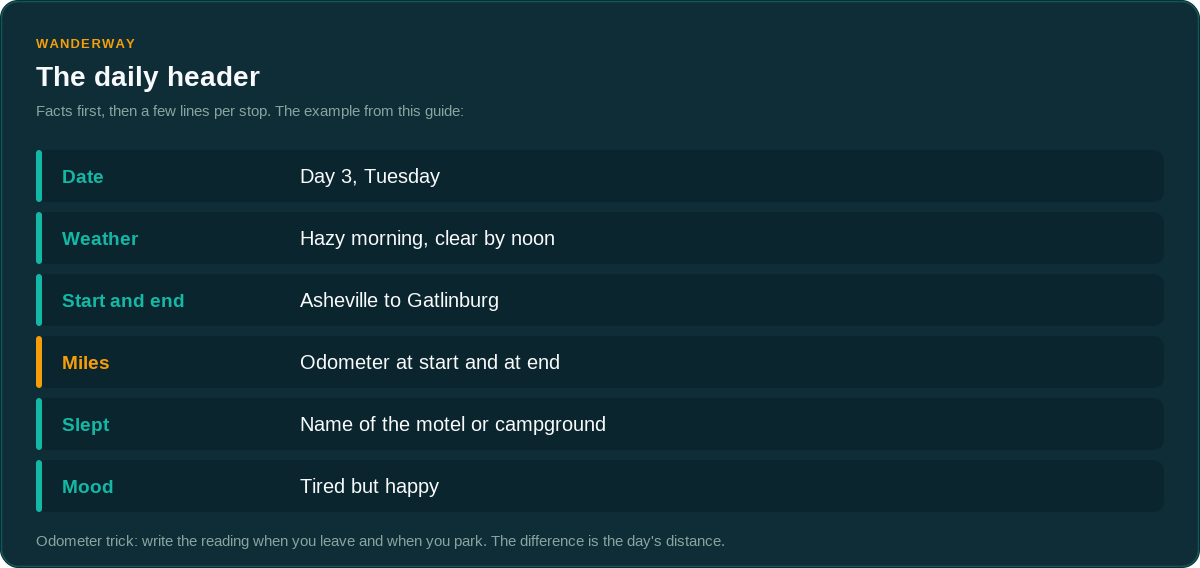
The Seattle Times, running a piece by Jenna Schnuer of The New York Times, recommends starting every entry with metadata: date, time, weather, location and a mood note. It borrows the habit from scientific field journals. For a road trip, a header can look like this:
| Field | Example |
|---|---|
| Date | Day 3, Tuesday |
| Weather | Hazy morning, clear by noon |
| Start and end | Asheville to Gatlinburg |
| Miles | Odometer at start and at end |
| Slept | Name of the motel or campground |
| Mood | Tired but happy |
The odometer trick is simple. Write the reading when you leave and when you park for the night. The difference is the day’s distance, and you never have to reconstruct it from a map.
The stop lines
Under the header, add one short block per stop: where it was, the time, one photo and one line. Make the line specific. A vanlife trip-log guide offers a useful test: ask whether a note would change a decision next time. Entries like “lovely evening, beautiful views” tell you nothing later, while “parking lot fills by 10, bathrooms at the back” does.
Good candidates for a line:
- The exact turnoff or pull-off, so you can find it again.
- What it cost: fuel, tolls, parking, tickets. The same guide notes that costs fade from memory fastest.
- The best thing you ate, and where.
- A story you heard about the place.
- Something that went wrong. Vakantio’s journaling guide argues that mishaps become the favorite parts in a few years, and that matches what most families find.
One Route 66 logbook, published in August 2026, follows a similar pattern: date and weather, start and stop points, type of accommodation, miles, places visited, a few memories and a favorite photo. It aims for what you will actually want to remember, not every minute.
Keep it from becoming a chore
Most journals die because the entry feels like homework. A few rules keep the bar low.
Write short, and write soon. Vakantio suggests writing within 24 to 48 hours, because details fade, and says an entry can be as short as three sentences. It also recommends writing down numbers (prices, distances, temperatures) and quotes from people you met, since both are hard to recall later.
Pick a natural pause. National Geographic suggests blocking out time at a café, beach or park, or setting a phone reminder to jot down whatever comes to mind for five or ten minutes without judging it. On a road trip, the natural pauses are the gas stop, lunch and the evening after dinner.
Be present first. Beyer’s advice is to feel the moment, whether wonder or adrenaline, before you capture it. If the light on a ridge is stopping you in your tracks, look at it. The note can wait two minutes.
Use the sixty-second version on tired days. Three bullets: best stop, best line said in the car, what is planned for tomorrow. A day with three bullets is far better than a blank page.
Back it up. A notebook can get wet and a phone can break. Vakantio recommends keeping a second copy, and a quick photo of each page every few days does the job.
Who writes while the car is moving
The driver should not write, type or dictate long notes while driving. Make the passenger the journalist. If you are traveling alone, save your notes for stops. Park, then write. A quick voice memo made while parked at a pull-off is a good habit, and the Seattle Times piece quotes photographer Rob Stephenson on the power of sound: a fish market or a crowded sidewalk can evoke a place more vividly than a photograph.
Notebook, phone or both
There is no wrong format. A paper notebook suits sticker spreads, ticket stubs and doodles. A phone suits typing at a stoplight-free moment, voice notes and photos with location attached. History With Divya’s road trip guide describes a physical notebook, a digital document or app, or a hybrid, and recommends plain or dot-grid pages if you want freedom in how you lay things out.
A hybrid is the most forgiving for families: a cheap notebook in the glove box for paper keepsakes and kids’ drawings, and the phone for photos and quick audio.
If you go with a phone, you can lean on it for prompts too. Tools like location-based reminders can nudge you to jot a note when you reach a place you flagged, which helps when you tend to forget at the moment a stop ends.
A page layout that holds up for a week
Here is a simple structure you can copy into any notebook.
- First pages: an index. Add page numbers and a few keywords per entry as you go, which the Seattle Times piece recommends so you can find things later.
- Route page: a sketch or printout of the whole route, with a sticker or dot at each overnight stop.
- Daily spread: facts on the left (the header above), stop lines and one favorite photo on the right.
- Pocket or envelope: one zip bag or envelope for receipts, tickets, maps and small flat keepsakes. Date each item at night so you do not wonder later.
- Last page: a short reflection: best stop, best meal, funniest moment, what you would do differently.
If you want to add keepsakes, History With Divya suggests taping receipts with the total circled, photo corners with captions like a note about a wrong turn, and small labeled envelopes for cards. National Geographic suggests grouping archive items by date and location, and keeping the collection small enough that you will actually look through it.
Prompts for when nothing comes to mind
Pick one to three prompts a day and answer in bullet points. Perfect prose is not the goal. These work well from the passenger seat:
- What surprised you most today?
- Why did we stop here?
- What did we eat, and would we order it again?
- What would we tell someone driving this road next week?
- Describe the landscape in five words.
- What is the sound or smell you will remember from today?
- Who would we bring back here?
The prompts above are adapted from several road trip and travel journal guides. A “five senses” pass is also quick: one thing you saw, heard, smelled, tasted and touched, in about five minutes.
Some tiny habits add a lot over a week. Take one photo through the windshield at the same moment each morning, such as the first mile after breakfast, and ten in a row show how the land changed. Photograph the state-line signs. Write down the song that was playing during the best stretch.
Turning the drive itself into material
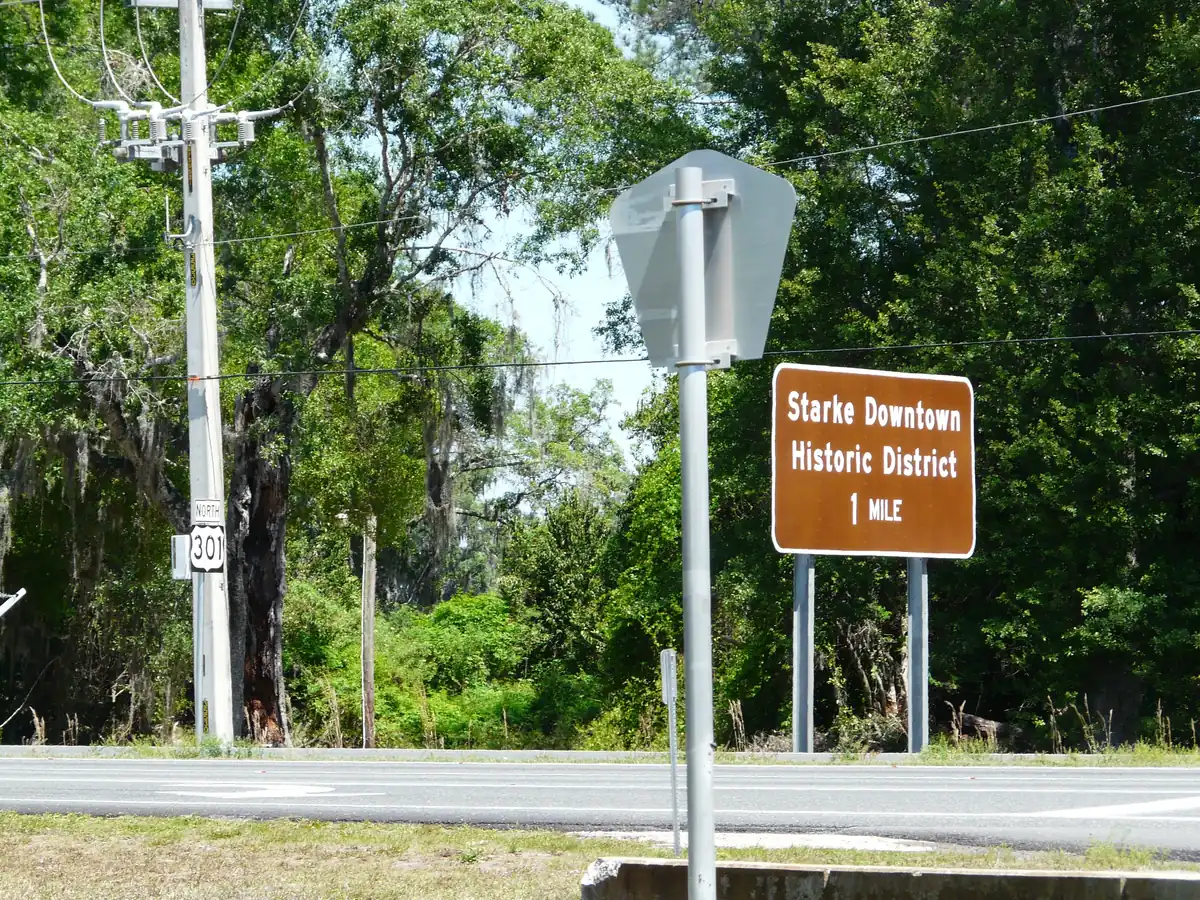
A journal is only as good as what you notice, and on a long drive it is easy to see a lot and learn very little about it. A sign says “Historic District” and you roll through. A bridge looks old, and you never find out why it is there.
This is where we think a driving app can do more than turn left at the right time. WanderWay combines navigation with live narration, so the stories about the places along your route reach you as you pass them. Each one is something to capture: a name, a date, a surprising detail, a reason the place exists. Write the one fact that made everyone in the car say “huh.” It becomes the line for that stop.
WanderWay also includes travel journaling for your trips. You can download area details and stories for offline use, which helps in mountain stretches where signal drops, and plan loop or out-and-back trips so the journal has a clear shape. If you are heading to a region with plenty of overlooks and history, such as our Great Smoky Mountains and Gatlinburg scenic drives, the stops practically write the entries for you.
Road trip journaling with kids

Children are often the best journalists in the car, as long as the job is small and fun. A few ideas that hold up:
One drawing, one sentence, one flat keepsake. Wonderkin Adventures describes the best kids’ journal as one drawing, one sentence and one flat keepsake per day. It uses three beats: what I felt, what I noticed, what I want to remember.
Save writing for rest stops. The same guide explains that reading or writing in a moving car can be a problem for kids prone to car sickness, because the inner ear senses motion while the eyes may not. A “rest-stop rule” of one five-minute entry after stretching legs avoids it.
Let them talk instead. Southfolk’s travel journal activity, written for ages 3 to 10, says that if writing causes motion sickness, children can dictate notes to another passenger. It also suggests noting one memorable thing at a time, adding weather, food or wildlife at stops, and finishing with one sentence about the best or most surprising part.
Collect things. Nemours KidsHealth suggests kids describe what they see and glue in small finds such as stones, shells or rest-stop trinkets, and even gives each child a disposable camera.
Let them own it. Embracing Homemaking recommends letting children build their own journal from a binder and lined paper, keeping a small pencil case in the glove compartment, writing your own entries alongside them, and skipping spelling corrections during the trip. Review after you get home instead.
WanderWay’s Kids Mode offers child-friendly stops and simplified stories, and Family Drives include kid stops and restroom breaks on longer drives. Those stops are natural moments for the rest-stop rule: stretch, look around, then write one line. You can read more on the WanderWay 2.6 update page.
A simple routine you can start tomorrow
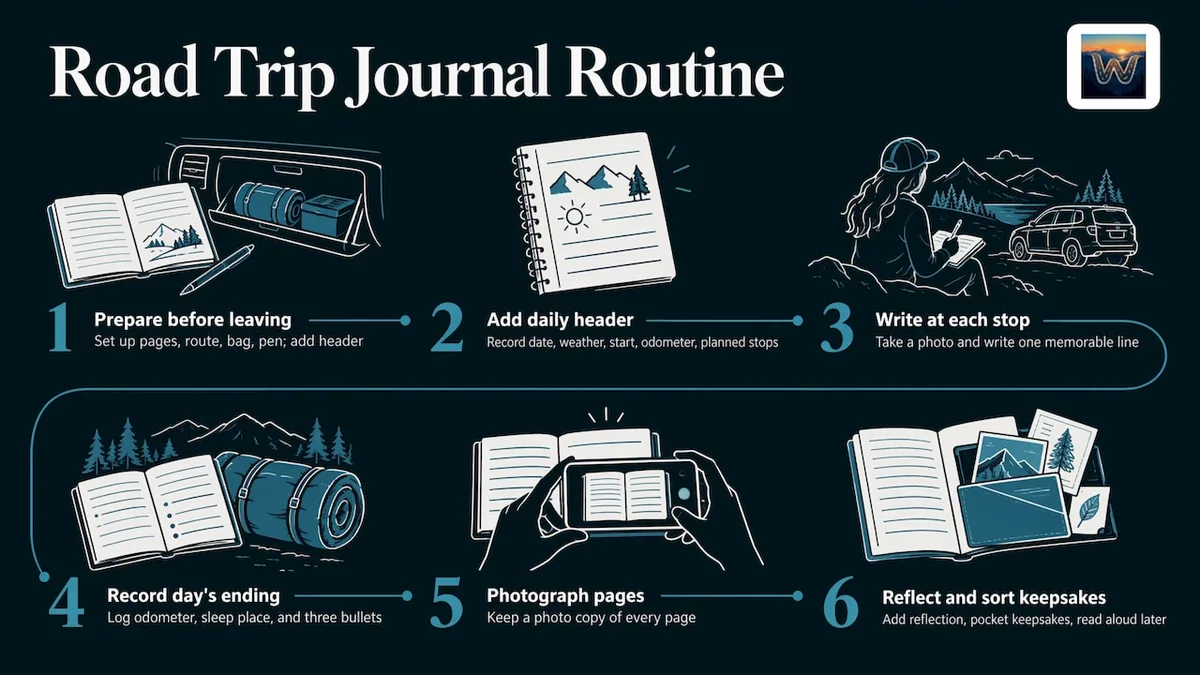
Before you leave. Prepare the journal: index pages, route page, a zip bag in the glove box and a pen that works. Put the first day’s header together.
At the start of each day. Write the date, weather, starting point and odometer. Note the stops you plan to make.
At each stop. Take one photo. Write one line. Let the passenger do it while the driver stretches. If a story from the drive stood out, put down the one detail that made it memorable.
At the end of the day. Write the odometer reading and where you slept. Add three bullets: best stop, best line from the car, tomorrow’s plan. If you have ten minutes, add a short free write of whatever you remember, without editing.
Once during the trip. Take a photo of each page, so the journal exists in two places.
After the trip. Add the last-page reflection and sort the keepsakes into the pocket. Read it to the family on the next long drive.
Try WanderWay for your next drive

If you want your road trip to come with stories worth journaling, WanderWay is built for it: navigation, live narration about the places you pass, and features made for families. It runs on iPhone, iPad, CarPlay and Mac. There is a free 14-day trial, and WanderWay Unlock is a one-time purchase of $7.99, with no ads and no subscription.
You can get WanderWay and try it on your next scenic drive, whether that is a weekend loop or a cross-country run.
FAQ
What should I write in a road trip journal?
Start each day with the date, weather, start and end points, miles and where you slept. Then add one line per stop: what it was, what it cost and one detail you want to remember. Finish with the best moment, funny moments and anything that went wrong.
How do I keep a road trip journal if I’m the driver?
Don’t write while driving. Hand the notes to a passenger, or wait until you park. At a gas stop or pull-off, take one photo and write or record one line. Then do a short wrap-up in the evening, when the car is off.
How long should each entry be?
Short is fine. Three sentences is enough, and a sixty-second version with three bullets works on tired days. Aim for a few lines per stop and one paragraph per day if you have more time. A short entry written the same day beats a long one you never write.
Is a notebook or an app better for a road trip journal?
Either works. A notebook is good for sketches, tickets and kids’ drawings. A phone is good for photos, voice notes and typing quickly. Many families use both: a notebook in the glove box and the phone for photos, with a photo of each page as a backup.
How can kids join in without getting carsick?
Save reading and writing for rest stops, and let kids speak their notes while you are moving so an adult can write them down at the next stop. Drawing at a stop, collecting a flat keepsake and a one-sentence ending to the day all keep the job light.
Sources
- National Geographic: why you should keep a travel journal
- The Seattle Times: How to keep a travel journal
- Vanlifestuff: How to keep a trip log you’ll reread
- Vakantio: Writing a travel journal
- Nutty Hiker: Route 66 travel journal
- History With Divya: Road trip travel journal
- Wonderkin Adventures: Kids travel journal ideas
- Southfolk: Travel journal road trip activity for kids
- Nemours KidsHealth: Road trip boredom busters
- Embracing Homemaking: Car travel journal with your kids