Self-Guided Driving Tours: How to Plan One That Works
Get WanderWay on the App Store. Free to try, then a one-time unlock.
A self-guided driving tour is a route you drive on your own schedule, with stops, stories and scenery chosen in advance instead of delivered by a guide on a bus. You decide when to linger and when to move on. The tours that work best pair a realistic time budget with narration that explains what you are looking at, and that is exactly what WanderWay is built to deliver: scenic navigation with live stories about the places you pass, for road trips and everyday drives alike.
This guide covers what a self-guided tour is, how to choose one, how long to give it, how to keep kids happy, and how to prepare when the signal disappears.
Make Self-Guided Drives More Engaging WanderWay pairs navigation with live stories about scenic overlooks, historic landmarks and nature preserves, including places along your route without constant internet connection. Visit
TL;DR
- A self-guided driving tour is a route with planned stops and stories that you drive at your own pace, from a 20-minute park loop to a week-long highway trip.
- Budget time by stops, not miles. Official park tours list both a no-stop time and a with-stops time, and the gap is large.
- Mix “known” stops you will not skip with optional ones, and leave buffers for fuel, restrooms and weather.
- With kids, plan a real break about every two hours and treat the stop itself as part of the fun.
- Download maps and stories before you leave, because many scenic areas have no cell coverage.
What a self-guided driving tour is
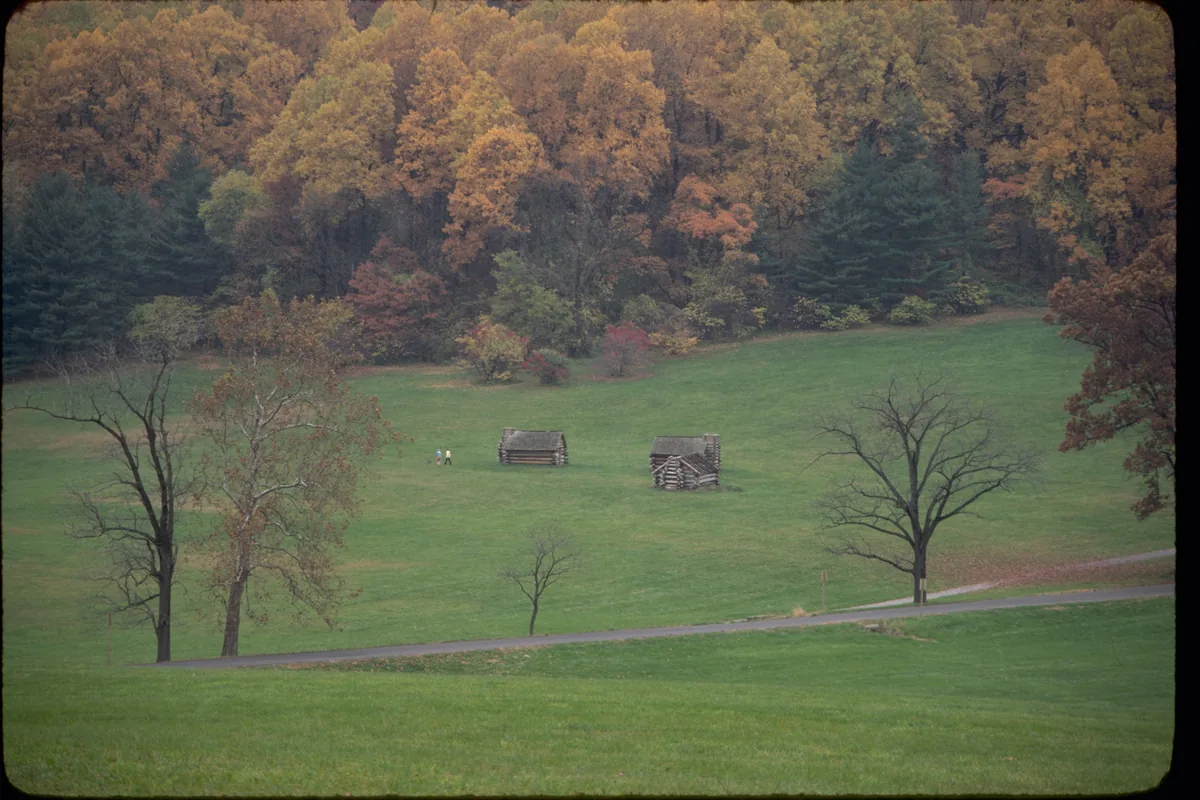
The idea is simple. Someone has already worked out a good route, the stops worth getting out for, and the story behind each one. You supply the car, the schedule and the curiosity.
The classic versions come from public land managers. The National Park Service runs auto tours in many parks, delivered through brochures, apps, cell phone guides or audio files. The Valley Forge Encampment Tour is a good model: a 10-mile loop with nine stops covering the park’s history and views. Driving all nine takes about 20 minutes without stopping, or up to 2 hours if you explore each one. The road is open daily from 7 AM to 30 minutes past sunset.
That range tells you the main thing about self-guided tours. The route is fixed, but the experience stretches or shrinks with you.
There is also a looser kind. You do not need a national park to have a self-guided tour. A coastal highway, a county back road with a few historic markers or a ridge route near home can be a tour once you know where the overlooks, landmarks and stories are. That is the idea behind everyday scenic driving: the same commute or Sunday outing, turned into something worth remembering.
Why drive it yourself
Three things set self-driven tours apart from a bus or van tour.
- Pace. Stay twenty minutes at an overlook because the light is perfect, or skip a stop that does not interest you.
- Flexibility. Weather turns, a child falls asleep, a side road looks promising. You adjust without asking anyone.
- Fit. A history lover can focus on battlefields and landmarks. A family can stack playground and picnic stops between the sights.
The trade-off is that the planning is yours. That is where most people either overcommit or miss the best parts, so the next sections are about getting it right.
How to choose a tour that fits you
Start with three questions.
What do you want to feel at the end?
Pick the theme first. Scenery, local history, nature, or an easy outing with kids all lead to different routes. National park loops suit scenery and geology. Historic parks suit history. Small-town byways suit a mix.
How much time do you really have?
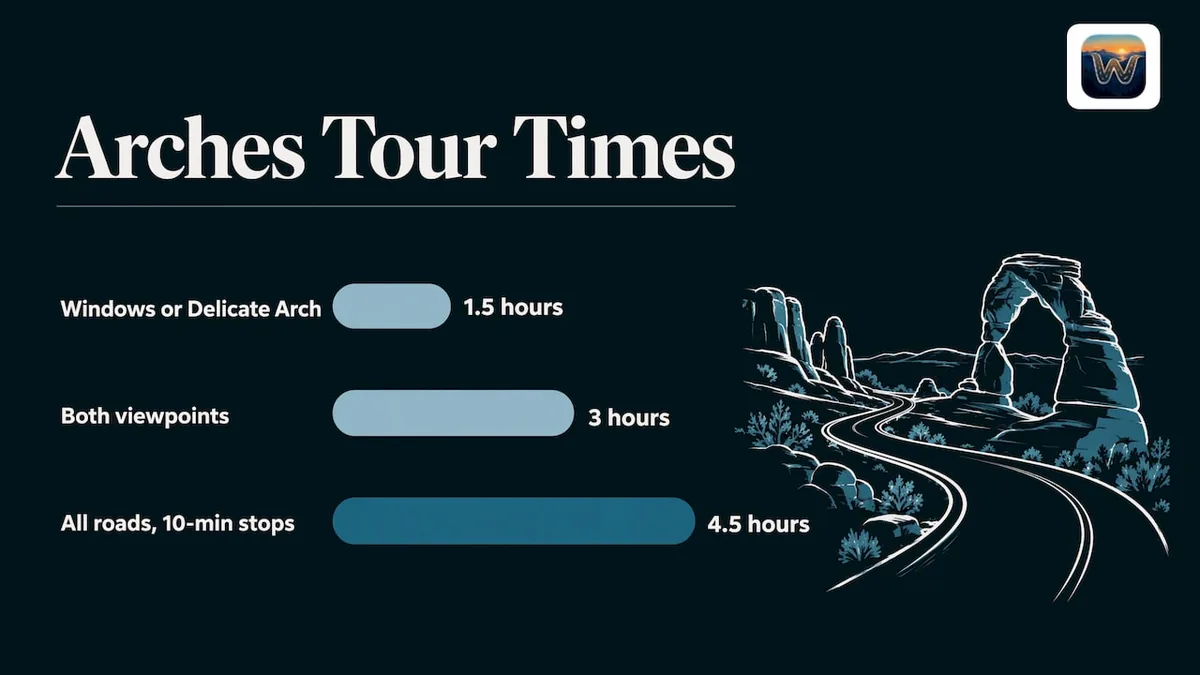
Be honest about the clock. A tour that takes 4.5 hours does not fit a 2-hour window, however pretty it is. The Arches National Park auto-touring page shows how to read this well: it offers about 1.5 hours for The Windows Section or the Delicate Arch Viewpoint, 3 hours for both, and 4.5 hours to drive all the paved park roads with 10 minutes at each viewpoint. Choosing among those options is the whole planning job in miniature.
For longer trips, scale up with the same honesty. Rick Steves’ team notes that Iceland’s 800-mile Ring Road needs about 30 hours of driving with scenic detours, and recommends a week as a comfortable minimum, with overnight stops spaced about five hours apart. Add the sightseeing to the driving time before you commit.
What can your vehicle and comfort level handle?
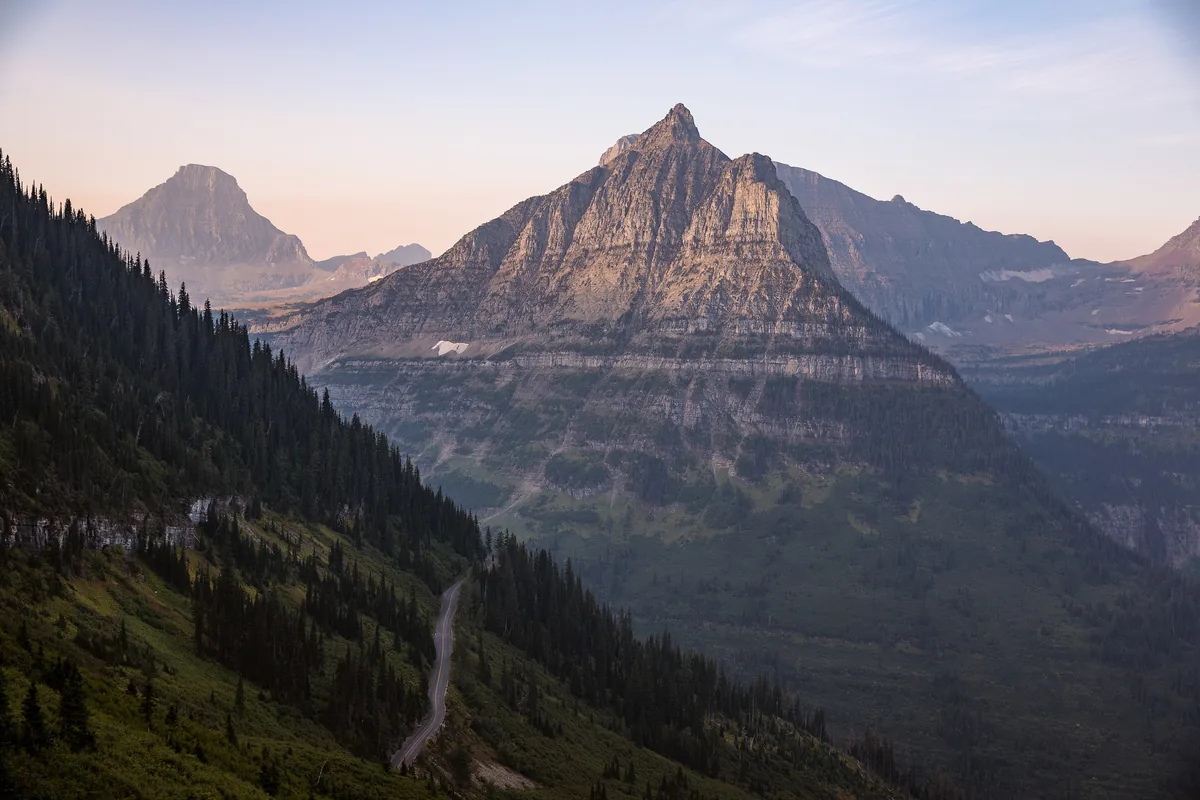
Check the road, not just the destination. The Arches page notes that unpaved roads there can require high-clearance, low-range four-wheel drive, and that you should check conditions at the visitor center. Narrow mountain roads, seasonal closures and vehicle length limits matter just as much. Glacier National Park’s 50-mile Going-to-the-Sun Road, built in the late 1920s and early 1930s, has its own NPS audio tour, and it is a good reminder that famous roads come with rules about size, season and traffic. Read the official page for current conditions before you go.
Build a time budget that holds up
The most useful habit is to budget from stops, not miles. Here is a simple way to do it.
- List your known stops. These are the two or three places you would be disappointed to miss.
- Add optional stops. These are the extras you will take if time and energy allow and skip without regret.
- Estimate time at each stop. Ten minutes for a viewpoint, thirty to sixty for a historic site or short walk.
- Add driving time between them.
- Add buffers for fuel, restrooms, photos, traffic, weather and road work.
One 2026 road trip planning checklist suggests aiming for 2 to 4 hours of driving on standard days and splitting stops into known and optional, a rule that works on any tour. Its author’s argument is that the best trips leave room for unplanned discoveries, so do not fill every daylight hour.
A worked example
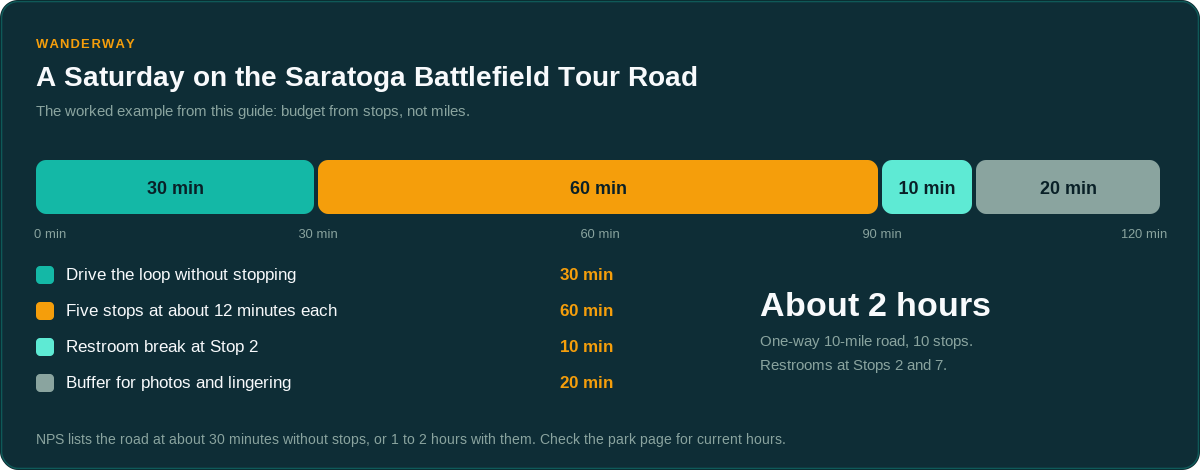
Say you have a Saturday afternoon and want to drive the Saratoga Battlefield Tour Road in New York. The National Park Service page describes a one-way 10-mile road with 10 stops at significant 1777 Revolutionary War sites. It takes about 30 minutes without stops or 1 to 2 hours with them, and restrooms are available at Stops 2 and 7.
Your budget might look like this:
| Item | Time |
|---|---|
| Drive the loop without stopping | 30 min |
| Five stops at about 12 minutes each | 60 min |
| Restroom break at Stop 2 | 10 min |
| Buffer for photos and lingering | 20 min |
| Total | about 2 hours |
Now you know to start by mid-afternoon, and you know which stops to treat as known and which as optional if the light fades.
Timing, access and passes
Some tours need reservations or permits, and those are easy to miss. The National Park Service’s Valles Caldera self-guided auto tour runs 3 to 4 hours through front-country and backcountry roads, and the backcountry stops require a daily vehicle pass reserved through Recreation.gov up to three months ahead. A tour like that rewards planning well before the day you drive.
Hours matter too. Valley Forge’s tour road closes 30 minutes after sunset, which in November arrives early. Always check the park’s own page for current hours, seasonal closures and alerts, since roads can close for snow, ice or fire.
Early starts help on popular roads. Park Atlas, a park-travel guide, argues that famous park drives are better before 9 a.m., with lighter traffic, open parking and low light on the scenery. Even on a quiet county road, an early start gives you more flexibility if something runs long.
Make the drive engaging, not just pretty
A beautiful road with no context goes by in a blur. The difference between a drive and a tour is the story.
Good tours layer three things:
- Scenic stops: overlooks, pull-offs, ridges and shorelines where the view is the reason to park.
- Local history: the battle that happened in that field, the family who built the mill, the reason the road exists at all.
- Narration at the right moment: a short story as you approach a place is worth more than a long one you hear after you pass it.
This is where an app earns its place in the car. WanderWay narrates live as you drive, so the stories about what you are passing arrive while you are passing it. It curates hidden gems such as scenic overlooks, historic landmarks and nature preserves, and it puts the emphasis on local storytelling. You can set your scenic preferences so the suggestions lean toward what you enjoy, whether that is history, nature or simply the prettiest road.
It also fits trips that are not vacations. WanderWay supports loop and out-and-back trip planning, so a weekend drive can start and end at your door, and a travel journal lets you keep a record of where you went. If you are traveling with friends in more than one vehicle, multi-car route coordination helps everyone follow the same plan.
Plan for kids
Families are the group most likely to overplan a tour. The common mistake is routing the trip the way an adult-only trip would be routed. Young children need to move, and restlessness in a car seat builds up as the hours pass.
A few habits make family tours far smoother:
- Break often. The UK’s Automobile Association recommends a 15-minute break for every 2 hours of driving, with stretching, bathroom stops and a refresh of drinks and snacks. Its logic is that concentration cannot be sustained for hours, and passengers get uncomfortable too. Kids usually need a break sooner than the adults do.
- Make the stop the activity. A pull-off with a short trail, a historic marker with a story or a picnic spot works better than a long stretch with nothing in it.
- Know where the restrooms are before you need them. Saratoga’s tour road, for example, lists restrooms at only two of its ten stops.
- Keep the car entertaining. The same AA guidance suggests games such as Eye Spy, sing-alongs, trivia about your surroundings and scavenger hunts.
- Leave slack in the day. A shorter route with time to play beats a long one that ends in tears.
WanderWay has features for exactly this. Kids Mode offers child-friendly stops and simplified stories, so younger passengers get narration pitched at their level. Family Drives adds restroom and kid stops along the way, and the app can locate restrooms on long trips, which takes much of the guesswork out of the stretches between services.
Prepare for no signal
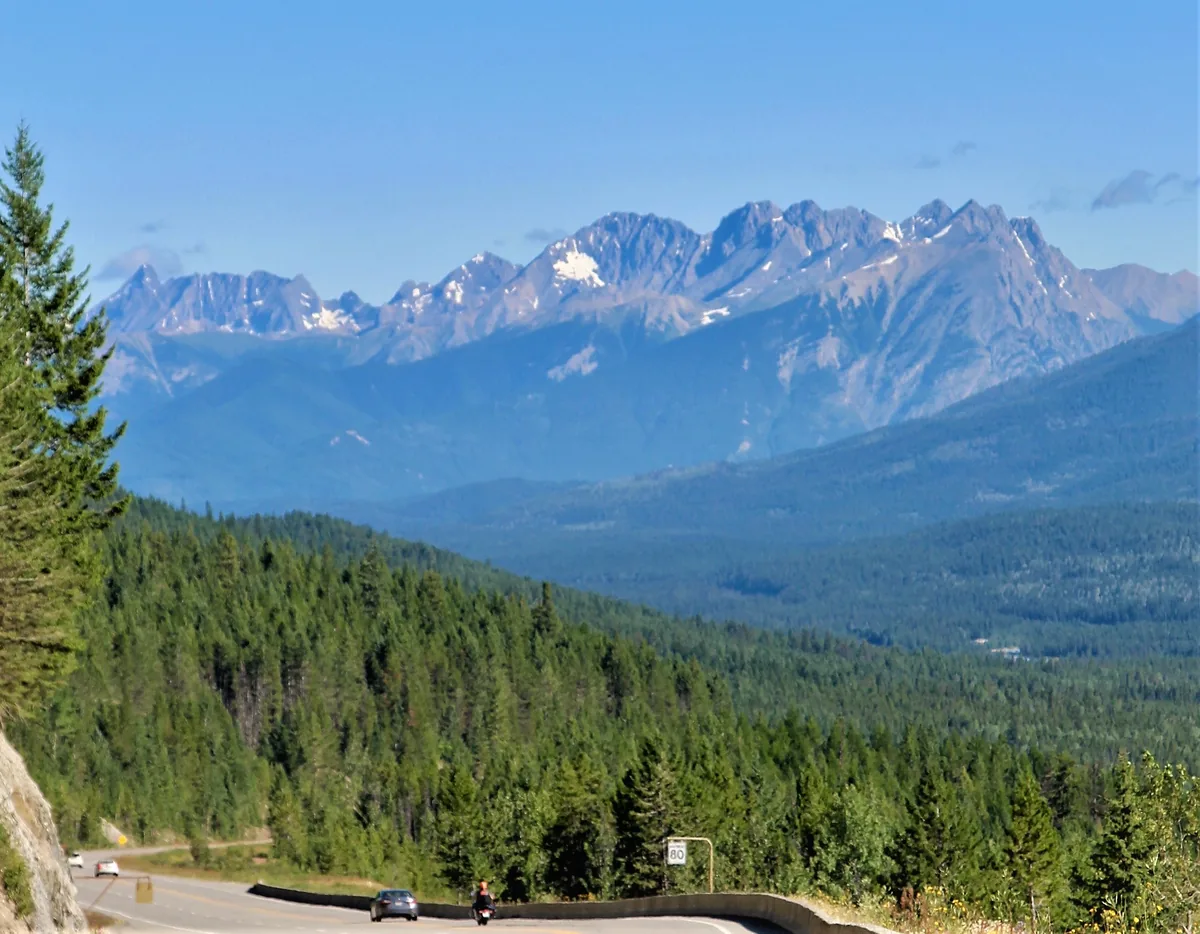
Many of the best scenic roads are the ones where phones stop working. Parks Canada’s Kootenay scenic drive is a 94-kilometre self-guided drive on the Banff-Windermere Highway, which opened in 1923, crossing two mountain passes. The agency warns that there is no cell coverage in the park and tells visitors to download the app before they go. That advice applies well beyond Canada.
Before you leave:
- Download maps and stories at home on Wi-Fi, not at the trailhead.
- Fuel up at the gateway town. Services inside parks and remote areas are sparse.
- Check official alerts the morning you drive, since closures from snow, ice, fire or wildlife happen.
- Know your vehicle’s limits for length, height and road surface.
- Tell someone your route if you are heading somewhere remote.
WanderWay is designed for this. You can explore places along your route without a constant internet connection, and offline areas and stories can be downloaded ahead of time, so the narration keeps going when the bars drop.
Set your route and start the audio before you pull out, and let a passenger handle any changes. Keep your attention on the road.
Try WanderWay on your next drive
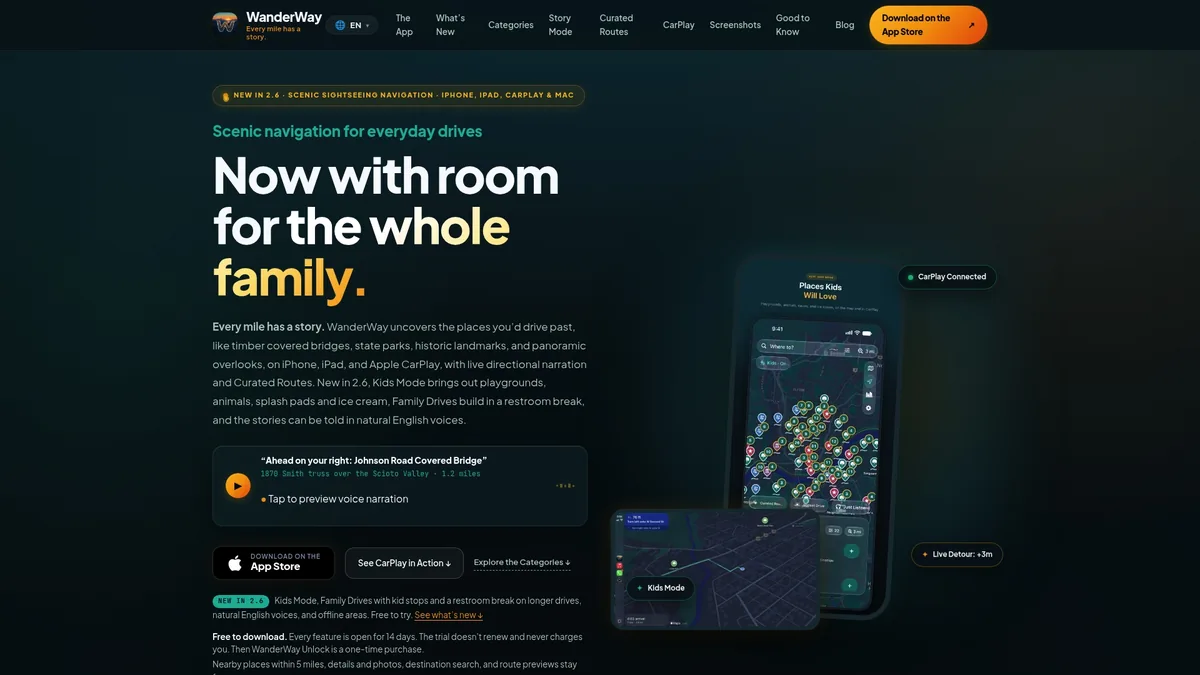
If you want one app that handles navigation, scenic routes and the stories behind them, WanderWay runs on iPhone, iPad, CarPlay and Mac. You can try it free for 14 days. After that, WanderWay Unlock is a one-time purchase with no ads and no subscriptions, and certain basic features stay free. You can find the current Unlock details on the WanderWay site.
The free trial is long enough to test it on a commute, a weekend loop and one longer family drive, which are three very different kinds of trip.
A simple planning checklist
Use this before any self-guided tour, whether it is 10 miles or 800.
- Choose a theme: scenery, history, nature or family fun.
- Check the official page for hours, closures, passes and vehicle limits.
- List known stops and optional stops.
- Budget time from stops, then add buffers.
- Plan restroom, fuel and food breaks.
- Download maps and stories offline.
- Start early where the road is popular.
- Leave an empty hour for whatever you did not plan.
FAQ
What is a self-guided driving tour?
It is a route you drive yourself, with recommended stops and information about each one. The guidance can come from a brochure, an audio file, a phone app or a narrated navigation app. You set the pace and can skip or extend any stop.
How long does a self-guided driving tour take?
It depends on the route and how often you stop. Official park tours show the range: the Valley Forge loop takes about 20 minutes without stops and up to 2 hours with them, while the Valles Caldera tour runs 3 to 4 hours. Budget from your stops, then add buffer time.
Do I need cell service for a self-guided tour?
Not if you prepare. Many scenic areas have no coverage, and Parks Canada tells Kootenay visitors to download the app in advance. Download your maps and stories before you leave. WanderWay lets you explore places along your route without a constant connection.
Can I do a self-guided tour with young children?
Yes, and it is often easier than a group tour because you control the schedule. Plan a break about every two hours, choose stops with room to move and know where the restrooms are. WanderWay’s Kids Mode and Family Drives are built for this kind of trip.
Is a self-guided tour worth it on an everyday drive?
Yes. A familiar commute or weekend loop can hold overlooks, landmarks and stories you have never noticed. Narration and curated stops turn the same miles into something you look forward to.
Sources
- Drive the Encampment Tour Route, U.S. National Park Service
- Auto Touring, Arches National Park
- How to Drive Iceland’s Ring Road, Rick Steves Europe
- Going-to-the-Sun Road Audio Tour, Glacier National Park
- How to Plan a Road Trip Abroad: 2026 Checklist, DriveTheAtlas
- Take a Drive on the Battlefield Tour Road, U.S. National Park Service
- Take a Self-Guided Auto Tour of Valles Caldera, U.S. National Park Service
- The 10 Best Self-Guided Park Driving Tours, Park Atlas
- Planning a road trip in the UK, AA
- Scenic drives, Kootenay National Park, Parks Canada